
Preparing Your Sequencing-Only Project at Admera: Complete Guide
Our sequencing service is designed for labs that already excel at in‑house library preparation and want a fast, reliable, and flexible path to high‑quality data. Admera's sequencing-only service is designed for research teams that prefer to handle their own prep while leveraging our expertise in high-quality, fast-turnaround sequencing across multiple platforms.
In this guide, we'll walk you through everything you need to know about submitting your prepared libraries to Admera, from choosing the right platform to understanding what drives sequencing costs.
What’s Included in Our Sequencing-Only Service
When you submit prepared libraries to Admera, you get a streamlined workflow designed for efficiency and quality:
Library sample QC – Every library is assessed using Qubit, qPCR (for Illumina libraries), and TapeStation to ensure it meets sequencing standards
Sequencing – Your choice of Illumina, PacBio, or DNBseq platforms
Demultiplexing – Automated sample separation for multiplexed runs
FASTQ file delivery – Clean, ready-to-analyze data delivered via BaseSpace, AWS, or other transfer options
This service is ideal for teams that value control over their preparation process while relying on expert sequencing execution and minimal turnaround time.
Choosing the Right Sequencing Platform
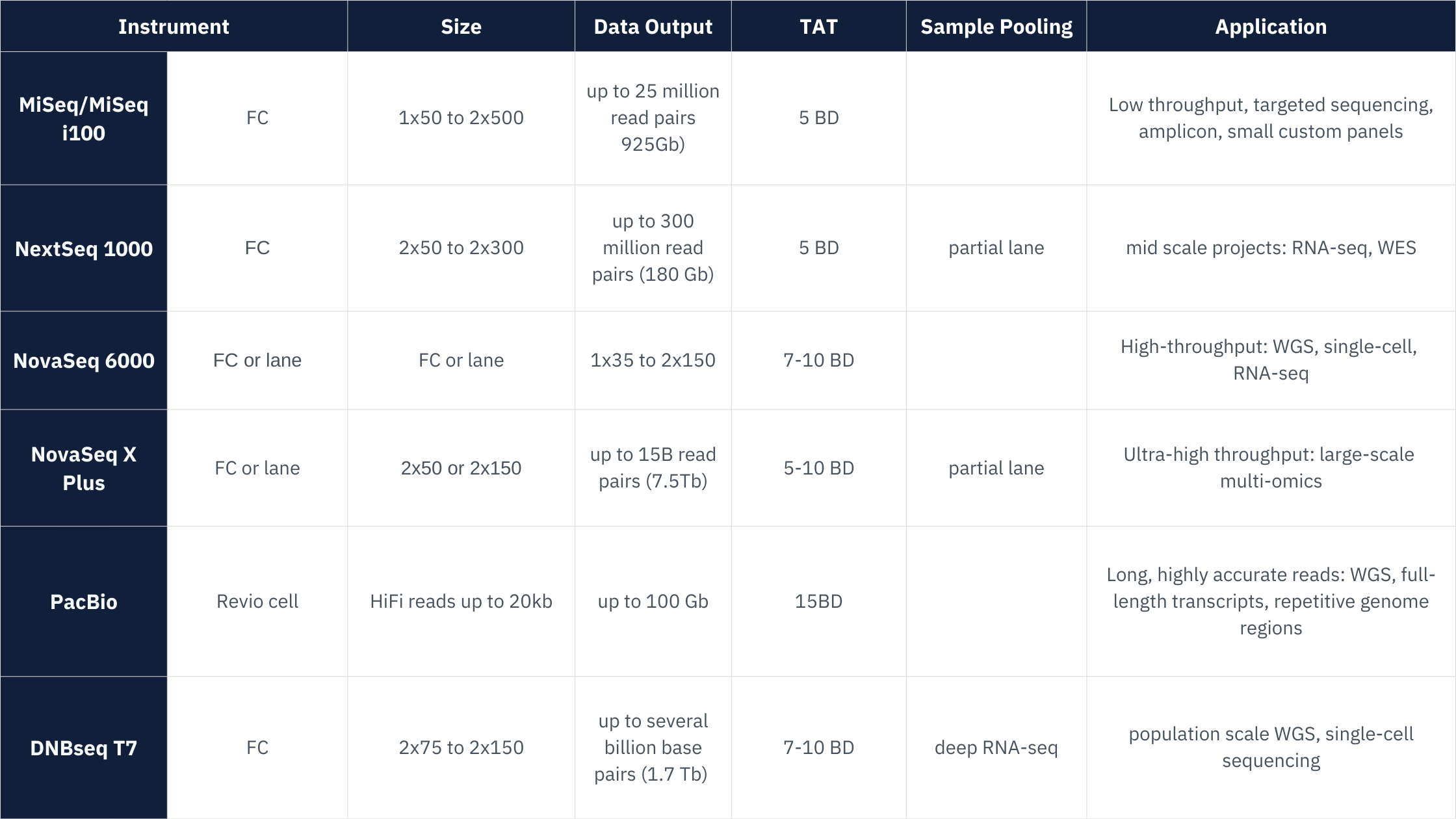
We offer a full range of sequencing platforms to match projects of any scale. Here's how to think about your options:
1.High-Throughput Platforms
NovaSeq X Plus & NovaSeq 6000
Best for large-scale studies requiring high data output at a cost-efficient price per sample. Ideal for whole-genome sequencing, large RNA-seq cohorts, and extensive variant screening projects.
2.Mid-Scale Platforms
NextSeq 1000
Provides a balanced option for mid-scale projects that need substantial throughput without the cost commitment of a full NovaSeq run. Perfect for targeted panels, transcriptome studies, and moderately sized sample sets.
3.Low-Throughput Platforms
MiSeq & MiSeq i100
Offers precision and flexibility for smaller, highly targeted applications. Great for amplicon sequencing, small gene panels, microbial sequencing, and pilot studies.
4.Specialized Platforms
PacBio
Supports long-read sequencing for applications requiring structural variant detection, full-length isoform analysis, and de novo assembly with HiFi accuracy.
DNBseq
Provides a high-quality, cost-effective alternative for diverse genomic workflows with competitive throughput and data quality.
How To Choose your Platform
To determine the right sequencing platform for your project, consider:
Number of samples – How many libraries are you sequencing?
Data output requirements – How much sequencing depth do you need per sample?
Turnaround time – What's your project timeline?
Larger studies with high data needs often benefit from high-throughput platforms, while smaller or targeted projects may be better suited to compact, lower-throughput instruments. Not sure which platform is right for you? Our team can help you optimize your sequencing strategy.
Understanding What Drives Sequencing Cost
Sequencing isn’t a one-size-fits-all. Several factors influence the final price of your project:
1. Platform Selection
Different instruments have different throughput capabilities and operating costs, which directly influence price per sample. High-throughput platforms typically offer lower per-sample costs for large projects, while low-throughput platforms may be more economical for small sample sets.
2. Read Length
Longer reads require more sequencing cycles, which increases both reagent consumption and run time. Paired-end 150 bp reads cost more than paired-end 75 bp reads, for example.
3. Lane or Flowcell Usage
Running a full lane or flowcell is more cost-efficient than partial usage. Under-filled runs spread fixed costs across fewer samples, increasing the per-sample price. Planning your projects to maximize lane utilization can significantly reduce costs.
4. Pooling Strategy
Efficient pooling maximizes data output per run and reduces cost. When multiple samples are pooled at appropriate ratios, you get the most value from each sequencing run. Suboptimal pooling can lead to wasted capacity or the need for additional sequencing, driving up costs.
Pro tip: Our team can help you design an efficient pooling strategy that balances your coverage needs with cost optimization.
How to Work with Admera: Sample Submission & QC
Sample Requirements
We have specific minimum concentration and volume requirements that vary by sequencing platform. Before shipping your libraries, reach out to us for detailed sample guidelines and shipping instructions tailored to your chosen platform.
Quality Control Process
All incoming libraries undergo rigorous QC to ensure they meet sequencing standards:
Qubit – Quantifies DNA/RNA concentration with high accuracy
qPCR – Validates library concentration and quality (Illumina libraries only)
TapeStation – Assesses library size distribution and detects adapter dimers or degradation
If any samples don't meet our QC thresholds, we'll contact you before proceeding to discuss options.
Data Delivery
After sequencing is complete, you'll receive:
FASTQ files – Demultiplexed and ready for analysis
QC metrics – Summary of sequencing performance
Flexible transfer options – BaseSpace, AWS, or other methods based on your preference
Whether you’re running a large-scale study or a focused pilot project, Admera’s sequencing only service gives you flexibility with a variety of cutting-edge sequencing platforms supporting diverse project needs with quick turnaround. Connect with our team to discuss your next project and optimize your sequencing strategy.